
Executive Perspective
High-performance AI models are rarely the result of one large labeling push. They come from a training data operating model: clear objectives, representative examples, controlled quality, evaluation discipline and a feedback loop from model errors back into dataset improvement. For US AI teams, this is how data becomes a repeatable advantage instead of a recurring bottleneck.
This article focuses on practical training data practices for CTOs, ML leads and product managers who need to move from experiments to reliable production systems.
Enterprise Decision Brief
High-performance models are built by organizations that manage training data as a product. That means roadmaps, owners, quality gates, versioning and investment decisions. Teams that treat data as a one-time prerequisite often find themselves buying more labels without improving the model behavior that matters.
| Operating Principle | Practical Move | Why Executives Should Care |
|---|---|---|
| Data has a roadmap | Plan datasets around release goals and known failure modes. | Focuses spend on measurable model improvement. |
| Quality is measured | Track agreement, audits, class coverage and model errors. | Improves confidence in release decisions. |
| Feedback is continuous | Use production errors to guide new annotation batches. | Turns data operations into a learning system. |
Recommendation: create a quarterly training data review with ML, product and operations leaders. The agenda should cover model failures, data gaps and the next dataset investments.
What It Means for AI Teams
Training data should be managed like a product
Good datasets have requirements, owners, acceptance criteria, version history and quality metrics. They also need roadmap planning because model needs change as products, users and edge cases evolve.
More data is not always better data
Adding volume without fixing definitions, class balance or edge-case coverage can make models harder to evaluate. Teams should invest in the examples that improve the decision the model needs to make.
Where It Fits in the ML Lifecycle
Training data best practices apply from collection through deployment. Dataset planning influences collection, annotation, QA, model evaluation, monitoring and retraining. Production feedback should shape the next data cycle.
A complete data strategy may use image annotation services, video annotation services, text annotation services, LiDAR annotation services, content moderation services and data audit services. Teams can contact Northern Base AI Labs for workflow planning.
Governance and Security Considerations
Training data governance covers source permissions, privacy, access control, label versioning, audit trails, retention and documentation. These details become more important as AI moves into customer-facing or regulated workflows.
Security and quality should work together. If data is over-restricted, reviewers may lose context. If access is too loose, business risk increases. The operating model should define the right balance for each dataset.
Industry Examples
- Computer vision: Teams improve performance by adding hard negatives, rare scenes and better evaluation slices.
- NLP: Teams update taxonomies when customer language changes or support workflows evolve.
- Moderation: Teams add new abuse examples as platform behavior changes.
- Robotics: Teams prioritize edge cases that affect navigation, safety and task completion.
Best Practices
Design evaluation sets carefully
Evaluation data should be stable, representative and protected from accidental training leakage. It should include high-value and high-risk slices.
Label for failure modes
Once a model exists, new data should target the model's weaknesses, not simply expand the average case.
Version guidelines and datasets
Teams should know which guideline version produced each label. Silent changes make model comparisons unreliable.
Close the loop with production feedback
False positives, false negatives, appeals, manual overrides and customer complaints should influence the next data batch.
Common Challenges
Common problems include class imbalance, stale examples, label drift, overfitting to clean data, missing edge cases, poor negative examples and unclear acceptance criteria. Teams also struggle when data ownership is split across engineering, product and operations without a shared process.
The business risk is slow iteration. Without a data operating model, each model improvement feels like a new emergency.
Benefits
- More predictable model improvement cycles.
- Cleaner evaluation and release decisions.
- Better alignment between product goals and dataset work.
- Lower long-term data cost through targeted collection and annotation.
Expert Insights
Expert insight: Mature AI teams do not ask only "How much data do we have?" They ask "Which model errors does this next dataset reduce?"
That question helps teams prioritize spending and avoid buying labels that do not change product outcomes.
How to Audit Dataset Coverage Before Collecting More Data
An ML team should not approve another collection effort until it can describe the gap the new data is meant to close. Dataset coverage is the degree to which training and validation data represent the conditions, classes and decisions the model will encounter after deployment. A coverage audit turns the broad request for “more data” into a testable question: which production condition is underrepresented, and what evidence shows that filling it should improve the model?
This process complements broader AI dataset curation practices. It focuses specifically on deciding whether collection is the correct next investment.
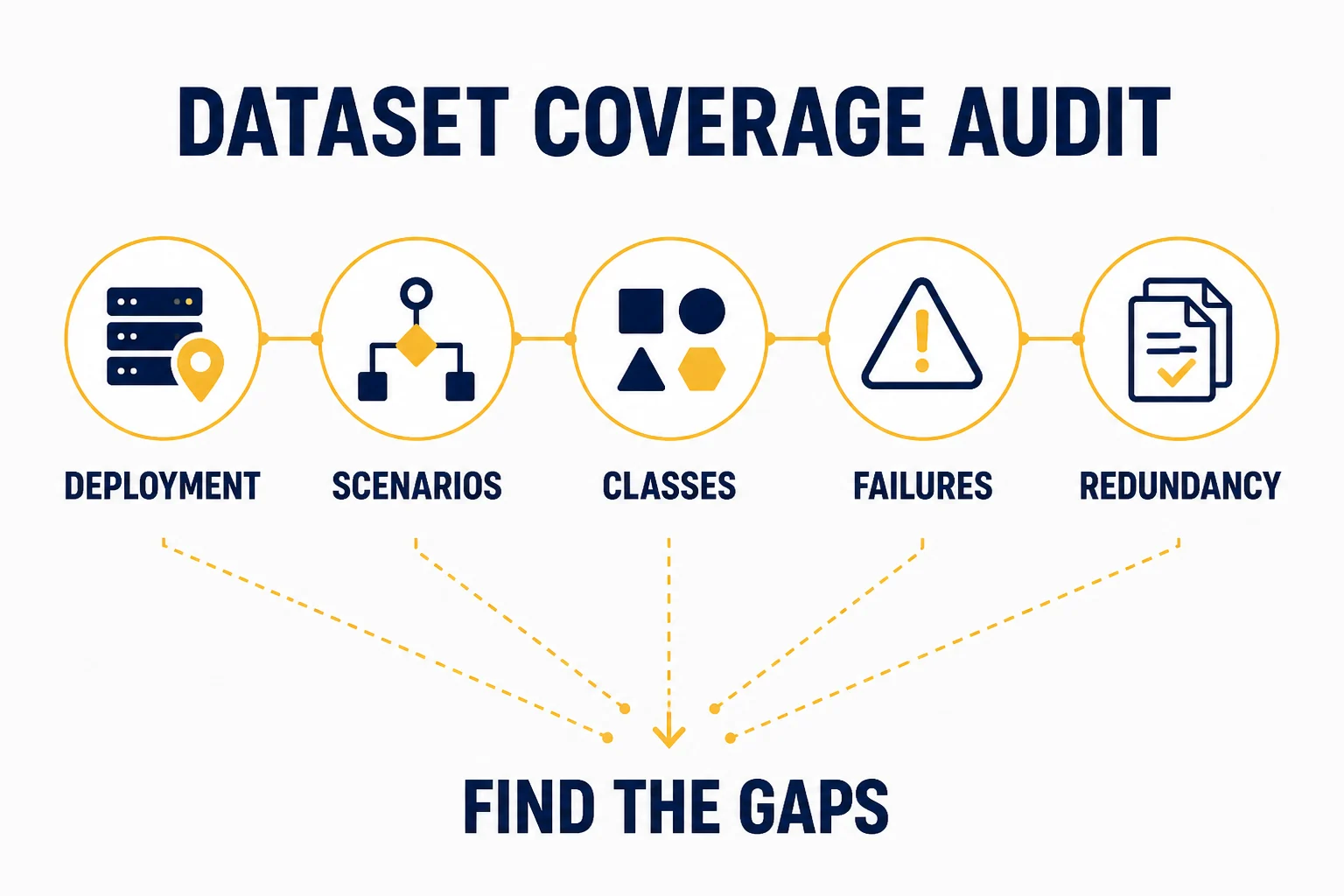
1. Define the deployment dimensions that matter
Start with the environment in which the model must make decisions. Select dimensions that can change the input or the consequence of an error. For a vision system, those might include location, camera or device, lighting, time of day, viewing angle, distance, background, object orientation, operating state and environmental conditions. A customer-facing classifier might instead require coverage by language, user segment, workflow state or input source.
Not every project needs every dimension. Choose dimensions from the actual deployment design, known risks and monitoring data. Document the allowed values for each dimension and identify combinations that are both plausible and important. This creates a production-oriented map against which the dataset can be compared.
2. Create a Scenario Coverage Matrix
Convert the deployment map into a Scenario Coverage Matrix. Counts alone are insufficient: compare the presence of each scenario in training and validation data with how often it occurs—and fails—in production. The values below are illustrative only.
| Scenario | Training Coverage | Validation Coverage | Production Frequency | Failure Frequency | Priority |
|---|---|---|---|---|---|
| Normal lighting | Strong | Strong | High | Low | Monitor |
| Low light | Weak | Limited | Medium | High | High |
| Strong reflections | Weak | Weak | Medium | Medium | High |
| Partial occlusion | Moderate | Weak | High | High | High |
| Unusual angle | Limited | Limited | Low | Medium | Review |
| New packaging | Missing | Missing | Growing | Unknown | Investigate |
The matrix exposes scenarios whose production frequency or business importance is meaningful while representation remains weak. It also prevents teams from prioritizing a rare condition merely because it is interesting. Priority should combine coverage, observed failure frequency, business impact and the confidence that additional data can address the problem.
3. Look for redundancy before measuring size
A dataset can contain millions of files while representing a narrow part of the operating environment. Near-duplicate images, burst captures, nearly identical video frames, repeated backgrounds, fixed camera positions and repeated easy examples can make volume look stronger than coverage.
Review similarity within each scenario and source. Sampling contact sheets, image embeddings, frame-distance checks and source metadata can reveal clusters that contribute little new variation. Duplicate examples are not always useless: repetition can reflect real production frequency or help with noise. The useful question is not simply, “Is this image new?” It is, “Does this image teach or test something meaningfully different?” This is the marginal information contributed by the sample.
4. Measure coverage within each class
Class counts hide variation. A class may contain 20,000 illustrative images, yet 18,000 could be front-facing, 1,500 slightly angled, 400 partially occluded and only 100 captured under difficult lighting. A large class count therefore does not establish broad class coverage.
Cross-tabulate each important class against relevant deployment dimensions. Look for empty or unusually thin cells, but interpret them with production context: not every class must appear equally in every condition. Pay particular attention to class-condition combinations connected to expensive errors, safety risks or frequent user interactions.
5. Compare training coverage with production failures
Production errors provide evidence about where the dataset may be incomplete. Categorize failures using the same scenarios and dimensions used in the coverage matrix. If a scenario repeatedly causes errors and has weak training representation, it becomes a strong candidate for targeted collection. The separate guide to computer vision production edge cases explains how to identify and categorize difficult visual conditions without treating every error as a data problem.
The diagnostic decision is essential. A failure may come from missing examples, but it can also result from an incorrect label, an ambiguous class definition, preprocessing, a camera limitation, model architecture or downstream production logic. Retraining should follow evidence, not every incident.
6. Create a failure-driven collection queue
Maintain a prioritized queue instead of continuously adding random samples. Each item can record the failure category, reviewed example count, production frequency, business impact, current dataset coverage, annotation requirement, collection priority, owner and review status. Attach representative examples and the evidence used to assign priority.
The queue connects monitoring with data operations. It gives collection and annotation teams a defined target, lets product owners compare business impact, and provides ML engineers with a hypothesis to test in the next evaluation cycle.
7. Establish stopping criteria
Collection plans need an exit condition. Additional data may no longer deserve priority when new batches are mostly redundant, coverage of important scenarios is stable, improvement per batch has become negligible, or business-critical evaluation slices meet agreed acceptance criteria.
Stop or redirect collection when the remaining evidence points elsewhere—for example, model architecture, annotation ambiguity, train-validation leakage, preprocessing or product logic. There is no universal numerical threshold. Define stopping criteria for the model, risk level and deployment environment before the batch begins so the decision is not distorted by sunk cost.
8. Measure the value of each data batch
Treat every targeted batch as an experiment: add the selected examples, preserve the dataset version, retrain or evaluate as appropriate, and compare the same important slices. Track overall metric change, critical-class change, difficult-condition performance, high-confidence errors and production-like evaluation slices.
The review should answer, “What did this new data actually improve?” rather than, “How many new images did we add?” A stable golden evaluation dataset helps teams compare batches without moving the benchmark each time.
9. When more data really does help
Additional volume is valuable when it adds relevant information. Strong reasons include underrepresented classes, rare but important scenarios, high visual variability, insufficient deployment coverage, new environments, new products or classes, new cameras and changing production distributions. The collection specification should name these gaps and describe how the new samples will be verified before annotation.
10. When more data is not the next move
Collection is a weak investment when the failure is already well represented or when the dataset has a different quality problem. The better move may be relabeling incorrect examples, clarifying annotation guidelines, resolving class ambiguity, removing noisy or redundant data, fixing train-validation leakage, improving evaluation slices, changing preprocessing, investigating model architecture or correcting production logic.
Before You Collect Another 10,000 Images
- Which production scenario is currently failing?
- Is that scenario represented in training data?
- Is it represented in validation data?
- Are the labels consistent?
- Are new samples meaningfully different from existing samples?
- Is the problem concentrated in particular classes or conditions?
- Did the previous data batch improve the affected evaluation slice?
- Would better labels, evaluation or model logic solve the problem more effectively?
Before collecting another dataset, find out what the current one is missing.
Northern Base AI Labs can help review dataset coverage, annotation consistency, edge cases and production failure patterns.
Implementation Roadmap
Start by defining the model decision, business metric and high-risk failure modes. Build a dataset plan that includes source data, label schema, QA process, evaluation slices and feedback from production.
Run annotation in measured batches. After each model evaluation, update data priorities based on observed errors. Keep a decision log so future teams understand why labels, classes or sampling rules changed.
Metrics to Track
Track class balance, slice coverage, label agreement, audit pass rate, dataset version, source quality, false positives, false negatives, model lift per batch and cost per useful improvement. These metrics connect data work to model value.
Visual Content Suggestions
Featured image recommendation: AI training data roadmap dashboard with model feedback loops.
Infographic recommendation: Dataset lifecycle from collection to deployment monitoring.
Diagram recommendation: Continuous improvement loop connecting model errors to new annotation batches.
FAQ
What makes training data high quality?
High-quality training data is representative, consistently labeled, well documented, secure, versioned and aligned with the model decision it supports.
Should teams collect more data or improve existing labels?
They should diagnose the failure first. Some problems need more examples, while others need clearer guidelines, audits or targeted relabeling.
How often should datasets be updated?
Datasets should be updated when products change, users shift, model errors reveal gaps or production monitoring shows new failure patterns.
Why does dataset versioning matter?
Versioning helps teams understand which labels, guidelines and data sources influenced each model result, making comparisons more reliable.
Related resources: Strengthen training data operations with the ground truth data guide, computer vision annotation guide, healthcare AI annotation, and contact us for data quality planning.
Conclusion
AI training data best practices are not a checklist for the annotation team. They are an operating model for improving model performance over time.
Enterprise teams that assign ownership, protect evaluation data, audit labels and close the loop between model errors and new datasets will make better release decisions and spend annotation budgets more effectively.